Financial-Fraud-India-2024-Research
India’s Financial Fraud Mitigation Framework FY 2024-2025
View Research Paper:

Independent Research by Modepalli Yogeswarachary
A comprehensive AI-driven approach to banking security and fraud prevention.
Research Overview
This repository contains comprehensive research analyzing India’s production-scale AI/ML fraud detection systems implemented by the Reserve Bank of India during fiscal year 2024-2025. The study evaluates real-world deployment of machine learning models achieving 90-95% detection accuracy and preventing losses exceeding ₹660 crore within the first six months of operation.
Key Highlights
| Metric | Value |
|---|---|
| Detection Accuracy | 90-95% (MuleHunter.AI) |
| Losses Prevented | ₹660+ crore (FRI, first 6 months) |
| Processing Latency | <100ms real-time scoring |
| Case Reduction | 33.5% YoY decrease in fraud frequency |
| Banks Integrated | 23+ major banks |
System Architecture
1. Early Warning System (EWS) Block Diagram
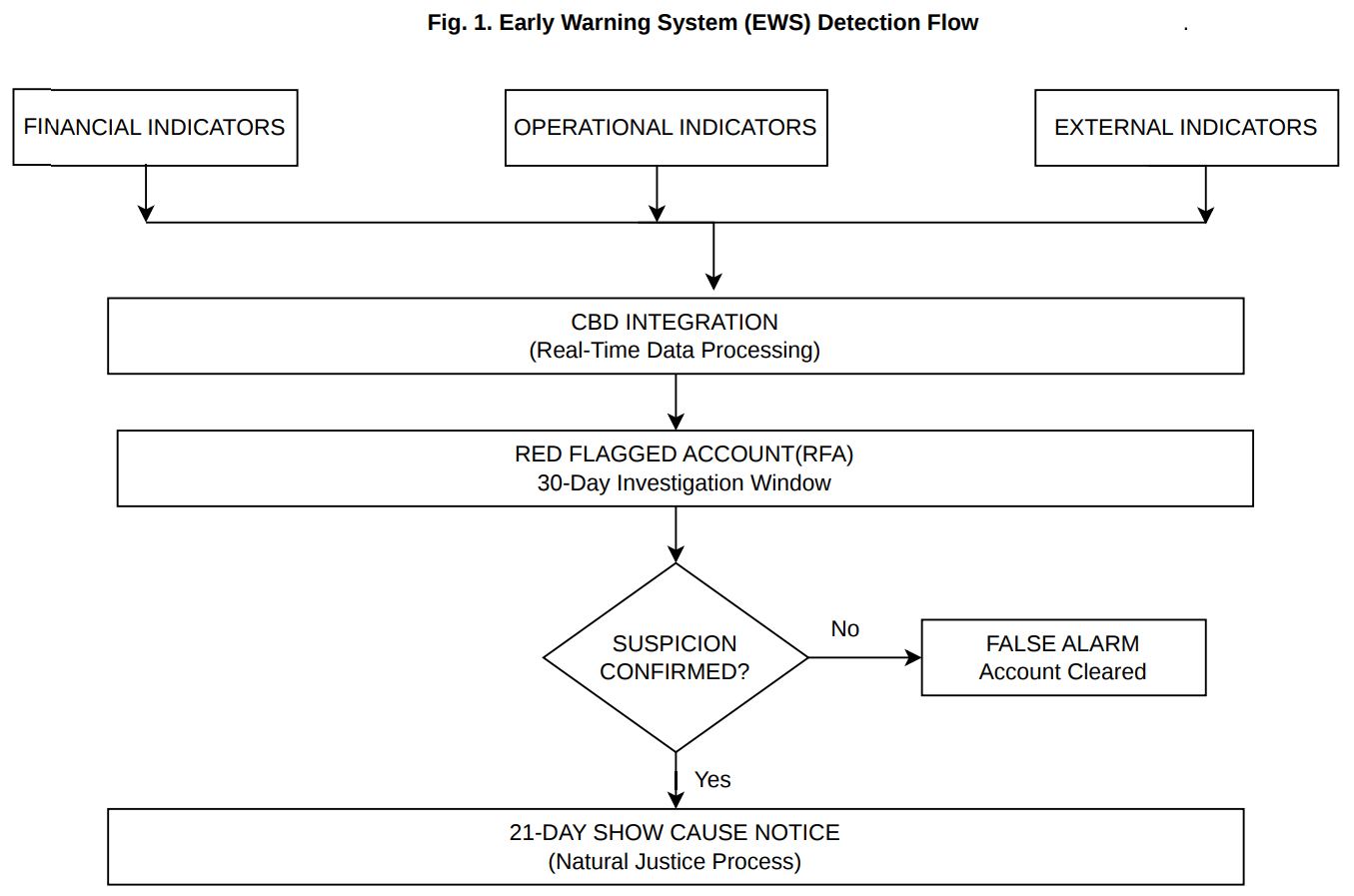
Key Indicators Detected:
- Financial: Fund siphoning (>50% to related parties), round-tripping (>3 layers), high-value cash transactions (>40% of loan)
- Operational: Auditor changes (>2/year), ghost inventory (>20% variance)
- External: Adverse media alerts, statutory defaults (>90 days)
2. Financial Fraud Risk Indicator (FRI) Block Diagram
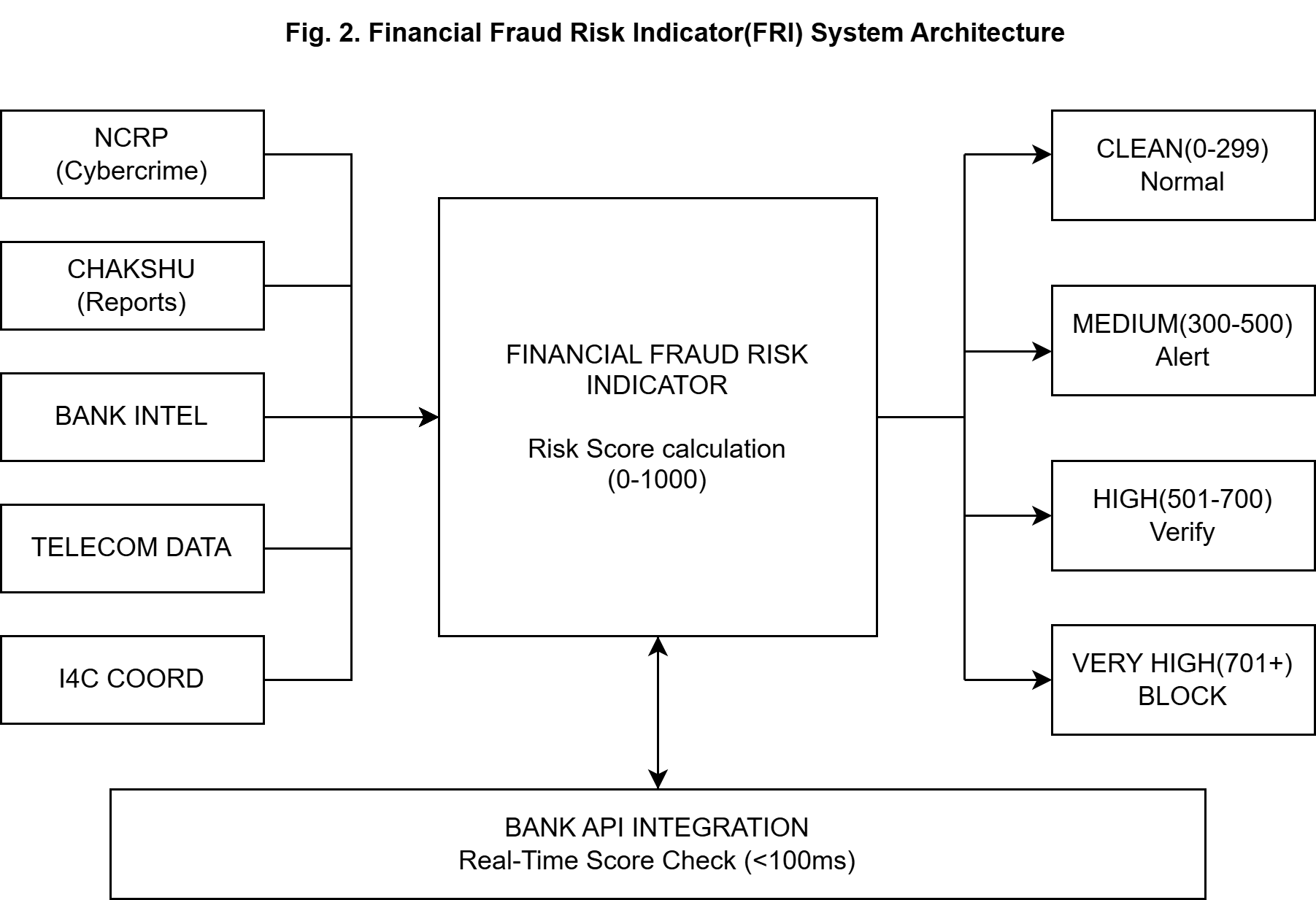
Risk Score Breakdown: | Risk Level | Score Range | Action | |————|————-|——–| | Clean | 0-299 | Normal processing | | Medium | 300-500 | Alert to customer | | High | 501-700 | Enhanced verification (OTP + Biometric) | | Very High | 701-1000 | Transaction declined |
3. Central Fraud Registry(CFR) Block Diagram
.png)
Behavioral Indicators (19 Patterns):
| Category | Indicators | Detection Logic |
|---|---|---|
| Velocity | Sudden Activation, High-Velocity Layering, UPI Velocity | Dormant >90d → Large deposit; >5 outgoing <1hr; >100 UPI/day |
| Pattern | Round Transactions, Balance Pattern, ATM Cash | In≈Out within 24hr; Near-zero balance; >80% withdrawal post-credit |
| Network | Contact Network, Referral Chain | Linked to flagged accounts; Multi-level referral deposits |
| Device | Device Multiplicity, Foreign IP, Emulator | >3 bank apps on 1 device; Non-Indian IP; Rooted/emulator |
| Anomaly | Temporal Anomaly, Profile Mismatch, SIM Swap | 11PM-1AM peak activity; Student→Business volume; Recent SIM change |
Technical Stack
Machine Learning Models Deployed
| Component | Algorithm | Purpose | Performance |
|---|---|---|---|
| Primary Classifier | XGBoost + Random Forest | Supervised classification | <50ms latency |
| Anomaly Detector | Isolation Forest | Unsupervised detection | <30ms latency |
| Network Analyzer | Graph Neural Networks | Transaction mapping | <20ms latency |
| Feature Store | Redis (In-Memory) | Real-time feature retrieval | <1ms latency |
| Inference Engine | NVIDIA TensorRT | GPU-accelerated scoring | <10ms latency |
Infrastructure Specifications
Processing Capacity: 73,000+ requests/second
Latency Requirement: <100ms end-to-end
Availability Target: 99.99% uptime
Data Sources: 5+ integrated systems
Model Retraining: Continuous learning pipeline
Research Findings
Fraud Statistics (FY 2024-2025)
Total Reported Fraud: ₹37,771 crore (23,879 cases)
├── Fresh Fraud: ₹17,340 crore (+54% YoY)
├── Legacy Reclassified: ₹18,674 crore (122 high-value accounts)
└── Case Frequency: -33.5% (improved prevention)

Sector Distribution:
├── Public Sector Banks: 70.7% of value (advance-related)
└── Private Sector Banks: 59.3% of cases (digital fraud)
Recovery & Impact
| Category | Amount Involved | Amount Recovered | Recovery Rate |
|---|---|---|---|
| Digital/Internet Fraud | ₹101.8 Cr | ₹48.37 Cr | 47.5% |
| Advance-Related Fraud | ₹33,148 Cr | Under investigation | Ongoing |
| Legacy Cases | ₹18,674 Cr | Under investigation | Ongoing |
Innovation Highlights
Framework for Responsible and Ethical Enablement of AI (FREE-AI 2025) Framework (7 Sutras)
Responsible AI deployment guidelines established in August 2025:
- Trust is the Foundation — Transparent, reliable systems
- People First — Human judgment augmentation
- Innovation over Restraint — Bold, socially useful innovation
- Fairness and Equity — Bias testing, representative data
- Accountability — Institution responsible for AI decisions
- Understandable by Design — Interpretable models, no black-box
- Safety, Resilience, Sustainability — Cyber-secure, adaptable systems
HaRBInger 2024 Hackathon Solutions
Future technology pipeline identified:
| Solution | Provider | Technology | Application |
|---|---|---|---|
| OneRadar | FPL Technologies | Real-time prediction + alerts | Customer feedback integration |
| Tokenized KYC | NapID Cybersec | Blockchain tokens | Identity theft prevention |
| Behavioral Biometrics | VisAst | AI/ML device analysis | Device-level authentication |
| Mule Detection | Epifi Technologies | Cross-bank analysis | Money laundering prevention |
Regulatory Framework
RBI Master Directions (July 2024)
Key mandates implemented:
- 21-Day Natural Justice: Procedural fairness framework
- Central Fraud Registry: Systemic debarment tracking
- EWS Mandatory: Early warning for loan frauds
- Real-Time Reporting: Sub-14 day fraud classification
Implementation Timeline
July 2024: EWS Framework Launch
    │
May 2025: FRI System Launch
    │
April 2025: DPIP Platform Launch
    │
August 2025: FREE-AI Framework Release
    │
2025: MuleHunter.AI Live at 23+ Banks
Professional Contributions
This research demonstrates expertise in:
- Production ML Systems: Architecting ensemble models at national scale
- Real-Time Processing: Sub-100ms latency for 73,000+ TPS
- Feature Engineering: 19 behavioral indicators for fraud detection
- Graph Analytics: Network-based mule ring detection
- Regulatory Compliance: RBI framework alignment
- Risk Scoring: 0-1000 risk classification system
- Cross-Functional Collaboration: Banking, telecom, regulatory integration
Key Technical Achievements
✅ 90-95% Detection Accuracy — 30% improvement over traditional systems
✅ <18 Minute Detection — 99% faster than manual processes
✅ ₹660+ Crore Prevented — First 6 months of FRI operation
✅ 23+ Banks Integrated — Scalable deployment across sector
✅ False Positive Reduction — 85% decrease (2-3% vs 15-20%)
References
- Reserve Bank of India, “Annual Report 2024-25: Trends in Banking Fraud,” RBI Publications, 2025.
- Ministry of Finance, “Parliamentary Question Response on Bank Frauds,” Government of India, 2025.
- RBI, “Master Directions on Fraud Risk Management,” RBI/2024-25/42, July 2024.
- RBI Innovation Hub, “MuleHunter.AI Technical Documentation,” RBIH Publications, 2025.
- NPCI, “Fraud Risk Management System Technical Specifications,” NPCI Technical Reports, 2025.
- RBI, “FREE-AI: Framework for Responsible and Ethical Enablement of AI,” RBI/2025-26/15, August 2025.
About the Researcher
Modepalli Yogeswarachary
Data Science Enthusiast | Transitioning Professional
Formerly: Senior Visa Consultant
Career Transition & Focus I am currently transitioning from a career in Global Mobility and Visa Consultancy to Data Science. My background in navigating complex regulatory frameworks and high-stakes documentation has given me a unique perspective on Data Governance and Predictive Modeling.
- Objective: Leveraging data-driven insights to solve complex business problems, specifically in Finance and Regulatory Tech.
- Core Competencies: Statistical Analysis, Python for Data Science, Machine Learning (Regression, Classification), and Data Visualization (Tableau/Power BI).
- Key Interest: Applying NLP and Predictive Analytics to automate and optimize legal/regulatory workflows.
🔍 Research Methodology
This framework is the result of independent research and data synthesis. The following methodology and tools were utilized to develop the multi-layered security approach:
- Data Sourcing: Primary research conducted via RBI Official Websites, National News Archives, and RBI Annual Reports (2023-2025).
- Data Synthesis: Utilized Microsoft Word and Openclaw to aggregate and synthesize qualitative data into a structured security framework, while maintainig the IEEE standards.
-
Visualization: Designed all architectural block diagrams and flowcharts using Draw.io to illustrate the AI-driven mitigation layers.